
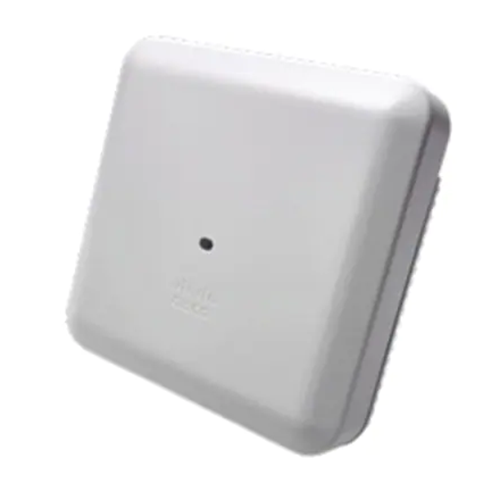
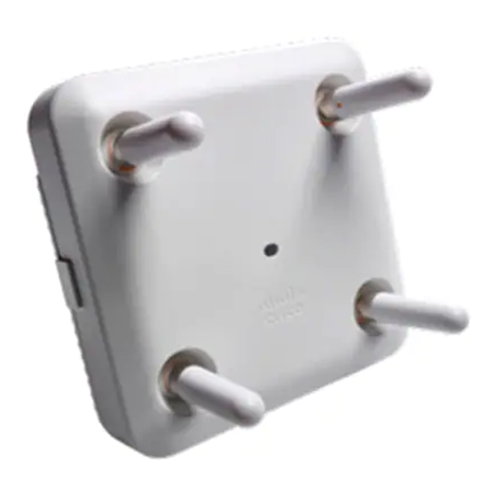
AIR-AP2802E-B-K9C Cisco Aironet 2800e WiFi5 Access Point

- 763 412 7282
- +86 010 69614620
AIR-AP2802E-B-K9C Overview
AIR-AP2802E-B-K9C exact order identity
AIR-AP2802E-B-K9C is a Cisco Aironet 2800 Series controller-based 802.11ac Wave 2 access point order. The exact line combines a 2802E indoor access point for external antennas, regulatory-domain token B, and a single-unit, configurable order.
Antenna boundary
Cisco documents four RP-TNC antenna connectors plus a Smart Antenna connector on the 2802E. Antennas are a separate engineered part of the deployment bill of materials. Before release, record each Cisco-supported antenna part number, connector use, gain, pattern, cable type, cable loss, mounting orientation and local approval. A connector fit alone does not establish RF performance or regulatory suitability.
Order-form boundary
Cisco's ordering convention uses K9C for a configurable single unit. The C suffix does not make the access point globally deployable; the final configured domain and destination approval must still be present on the quotation and received label. Hold the unit at receiving if the configured domain is absent or differs from the approved order. Preserve the configuration selection, chassis serial, destination evidence and controller-domain check as one release record. Because this is a configurable line, purchasing must retain the finally selected domain on both the authorized quotation and received label. The single unit needs one serial-level record, while accessories, controller readiness and destination approval remain separate acceptance items.
B regulatory-domain channel evidence
Cisco's 2800 Series data sheet lists the B profile as 2.4 GHz channels 1-11; 5 GHz blocks at 5.180-5.320, 5.500-5.720, and 5.745-5.825 GHz. The B plan contains a broad middle 5 GHz range followed by a separate upper block. Capacity planning should identify which radios use each block and should not copy a narrower domain's channel template.
Retain a controller export showing the enabled lower, middle and upper channel sets. Compare the installed country setting, dynamic channel assignment and survey plan before accepting the site. Regulatory-domain letters are identifiers, not country names; use Cisco's compliance tool for the actual deployment country and retain the lookup date.
Procurement inference: the comparatively broad middle range and separate upper range can influence how capacity is distributed across radios. Preserve the survey's planned channel groups and compare them with the controller's dynamic assignment after a representative operating period. If the destination authorization narrows the available set, update the capacity calculation and acceptance record rather than leaving a B-profile assumption in the design.
Deployment evidence worksheet
Power-state acceptance
Measure power after the access point has joined its controller and the planned radios and services are active. Record switch model, port, negotiated power level, LLDP result and any reduced-capability warning. An idle boot result is not sufficient evidence for the deployed power budget. If an injector is proposed, verify its supported use and include its exact identity in the maintained bill of materials rather than treating it as an unspecified accessory.
Ethernet and cabling proof
Preserve the permanent-link test, patch-lead identities, switch port, negotiated Ethernet rate and error counters. Investigate pair faults, excessive length or rate fallback before wireless acceptance begins. A link light only proves connectivity at some rate; it does not demonstrate the intended uplink performance. Tie the cable result to the AP serial so a later throughput problem can be separated from radio, controller and wired-path causes.
Serial-level asset control
Capture chassis serial, base MAC address, carton reference, deployment site, controller assignment and asset owner. Reconcile the identifiers against the purchase line before activation. Multi-unit cartons require an entry for every physical access point; a carton SKU alone cannot show which unit was installed, held as a spare or returned. This record is also needed to trace support entitlement, replacement history and monitoring ownership.
Country approval retention
Save the Cisco compliance lookup result, lookup date, deployment country, approved regulatory token and reviewer. If the destination changes, stop and repeat the approval rather than moving the unit on the strength of an earlier purchase. Compare the controller country setting and available channels with the retained evidence. Regulatory eligibility is a deployment condition and cannot be inferred from connector fit, stock location or a similar-looking part number.
Software lifecycle file
Record the controller release approved for this unit, the source used to verify support, the last tested date and the owner for software advisories. Available hardware does not prove compatibility with a current or future controller train. Review Cisco support information before every expansion or replacement. The lifecycle file should also state when this Aironet generation must leave service and which surrounding dependencies need migration.
Controlled spare policy
If purchased as a spare, name the protected site population, compatible controller image, storage location, storage conditions and periodic power-on test. Confirm that regulatory token, antenna architecture and mounting parts match the population it protects. Set a final-use review date. A stored unit can become unsuitable while untouched because controller software, country approval, certificates or network architecture may change.
Interference baseline
Preserve the pre-install and post-install noise, neighboring-radio and channel-occupancy observations for the selected location. Record any controller-driven channel change during acceptance. If the regulatory profile limits the channel choices, state how that constraint affected reuse and mitigation. This baseline gives future troubleshooting a reference point and prevents an unrelated interference change from being attributed to the hardware order.
Replacement dependency map
Map this unit to controller, licenses, authentication services, switch power, cable, bracket, antenna design and monitoring objects. For an end-of-sale platform, state which dependencies can be reused by the planned Catalyst migration and which require change. A nominal access-point replacement can fail when the surrounding platform was never inventoried. Keep the map with the asset rather than only in a one-time project file.
Related Aironet 2802 order records
- AIR-AP2802I-B-K9 - compare antenna architecture and regulatory-domain evidence.
- AIR-AP2802I-BK910C - compare antenna architecture and regulatory-domain evidence.
- AIR-AP2802I-BK910 - compare antenna architecture and regulatory-domain evidence.
Official evidence: Cisco Aironet 2800 Series data sheet; Cisco 2800 Series getting started guide; Cisco 2800 Series support and lifecycle page; and Cisco wireless compliance tool.
AIR-AP2802E-B-K9C Specification
| Exact model / SKU | AIR-AP2802E-B-K9C |
| Exact Cisco order model | AIR-AP2802E-B-K9C |
| Access-point family | Cisco Aironet 2800 Series |
| Wireless generation | Controller-based 802.11ac Wave 2 |
| Antenna architecture | External-antenna model; four RP-TNC connectors plus Smart Antenna connector |
| Antenna procurement boundary | Compatible antennas and installation hardware require a separate approved bill of materials |
| Order form | single-unit, configurable order |
| Physical unit quantity | 1 |
| Configuration state | Configurable order; retain final selected domain evidence |
| Regulatory-domain token | B |
| Cisco-listed channel profile | 2.4 GHz channels 1-11; 5 GHz blocks at 5.180-5.320, 5.500-5.720, and 5.745-5.825 GHz |
| Lifecycle | End of sale 31 October 2022; last support date 31 October 2027 |
| Migration family | Cisco Catalyst 9100 family; validate the exact replacement design |
| Source match | AIR-AP2802E-B-K9C: 2802E antenna form, B regulatory-domain profile, single-unit, configurable order, quantity 1 |
| Official manufacturer reference | Cisco Aironet 2800 Series official data sheet |
AIR-AP2802E-B-K9C Warranty
 | Product Quotation |  | Condition and Packaging |
 | Technical Support Enquiry |  | Returns and Replacement |
 | Shipping Arrangements |  | Warranty Terms |
AIR-AP2802E-B-K9C FAQ
What is AIR-AP2802E-B-K9C?
AIR-AP2802E-B-K9C Cisco Aironet 2800e WiFi5 Access Point is a CISCO Aironet 2800 Series Access Points product supplied by YYST Global for enterprise IT procurement and infrastructure projects.
What wireless generation is listed for AIR-AP2802E-B-K9C?
For AIR-AP2802E-B-K9C, the manufacturer specification lists wireless generation as Controller-based 802.11ac Wave 2.
What antenna architecture is listed for AIR-AP2802E-B-K9C?
For AIR-AP2802E-B-K9C, the manufacturer specification lists antenna architecture as External-antenna model; four RP-TNC connectors plus Smart Antenna connector.
What antenna procurement boundary is listed for AIR-AP2802E-B-K9C?
For AIR-AP2802E-B-K9C, the manufacturer specification lists antenna procurement boundary as Compatible antennas and installation hardware require a separate approved bill of materials.
Is AIR-AP2802E-B-K9C available from YYST Global?
Contact YYST Global to confirm availability for AIR-AP2802E-B-K9C, the required quantity, exact configuration, delivery destination and current lead time before ordering. A product listing does not confirm current inventory.
MODEL-SPECIFIC PROCUREMENT RESOURCE
Cisco Aironet 1832 and 2802 Ordering Guide
Decode antenna type, regulatory domain, 10-unit eco-pack and configurable-software suffixes across exact Aironet order lines.
Check this Aironet PID's antenna, regulatory domain, package quantity and software optionRelated products
Related AIR-AP2802E-B-K9C
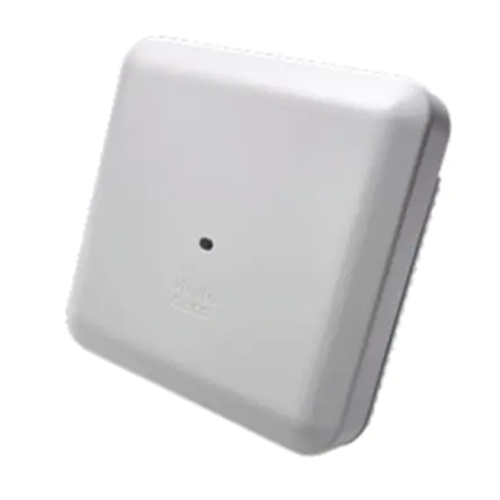
AIR-AP2802E-B-K9 Cisco Aironet 2800e 802.11ac Wave 2 Access Point
AIR-AP2802E-B-K9 is a 2802E indoor access point for external antennas supplied as a single-unit, fixed regulatory-domain order with regulatory-domain token B. Cisco lists its channel profile as 2.4 GHz channels 1-11; 5 GHz blocks at 5.180-5.320, 5.500-5.720, and 5.745-5.825 GHz. Verify destination approval, controller compatibility, exact quantity, antenna bill of materials and the 31 October 2027 support horizon before purchase.
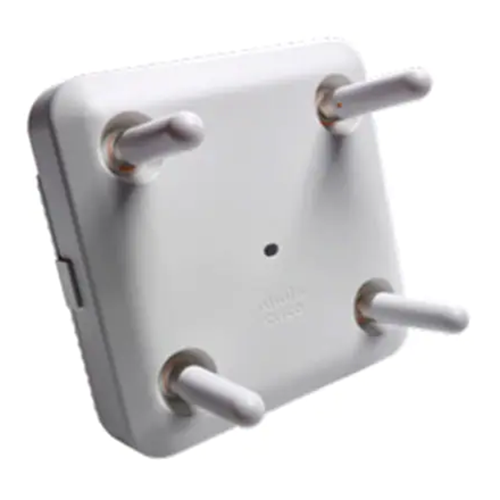
AIR-AP2802E-BK910 Cisco Aironet 2800e Eco-pack Wave 2 10 APs
AIR-AP2802E-BK910 is a 2802E indoor access point for external antennas supplied as a fixed-domain ten-unit eco-pack with regulatory-domain token B. Cisco lists its channel profile as 2.4 GHz channels 1-11; 5 GHz blocks at 5.180-5.320, 5.500-5.720, and 5.745-5.825 GHz. Verify destination approval, controller compatibility, exact quantity, antenna bill of materials and the 31 October 2027 support horizon before purchase.
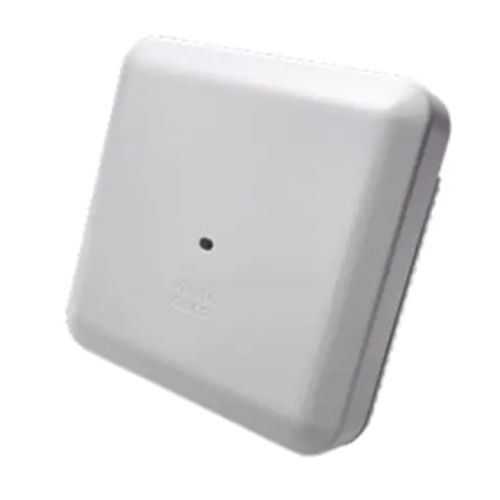
AIR-AP2802E-BK910C Cisco Aironet 2800e Dual-band 802.11a/g/n/ac 10 APs
AIR-AP2802E-BK910C is a 2802E indoor access point for external antennas supplied as a configurable ten-unit eco-pack with regulatory-domain token B. Cisco lists its channel profile as 2.4 GHz channels 1-11; 5 GHz blocks at 5.180-5.320, 5.500-5.720, and 5.745-5.825 GHz. Verify destination approval, controller compatibility, exact quantity, antenna bill of materials and the 31 October 2027 support horizon before purchase.
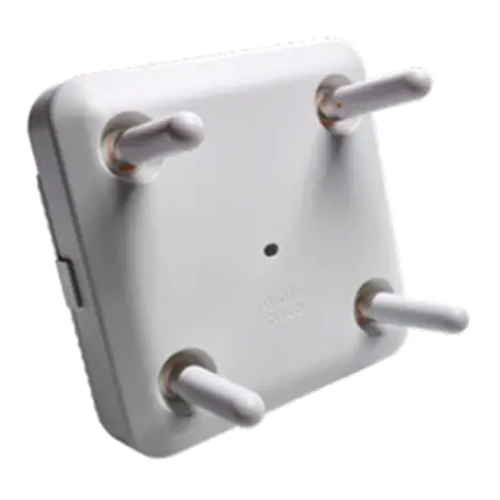
AIR-AP2802E-A-K9 Cisco Aironet 2800e Dual-band 802.11a/g/n/ac AP
AIR-AP2802E-A-K9 is a 2802E indoor access point for external antennas supplied as a single-unit, fixed regulatory-domain order with regulatory-domain token A. Cisco lists its channel profile as 2.4 GHz channels 1-11; 5 GHz blocks at 5.180-5.320, 5.500-5.700 excluding 5.600-5.640, and 5.745-5.825 GHz. Verify destination approval, controller compatibility, exact quantity, antenna bill of materials and the 31 October 2027 support horizon before purchase.
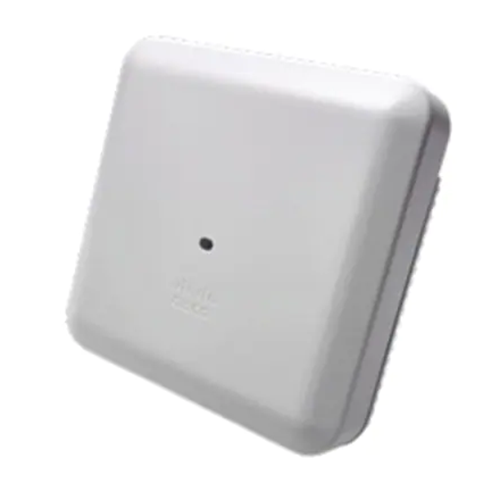
AIR-AP2802E-A-K9C Cisco Aironet 2800e 802.11ac Wave 2 Access Point
AIR-AP2802E-A-K9C is a 2802E indoor access point for external antennas supplied as a single-unit, configurable order with regulatory-domain token A. Cisco lists its channel profile as 2.4 GHz channels 1-11; 5 GHz blocks at 5.180-5.320, 5.500-5.700 excluding 5.600-5.640, and 5.745-5.825 GHz. Verify destination approval, controller compatibility, exact quantity, antenna bill of materials and the 31 October 2027 support horizon before purchase.
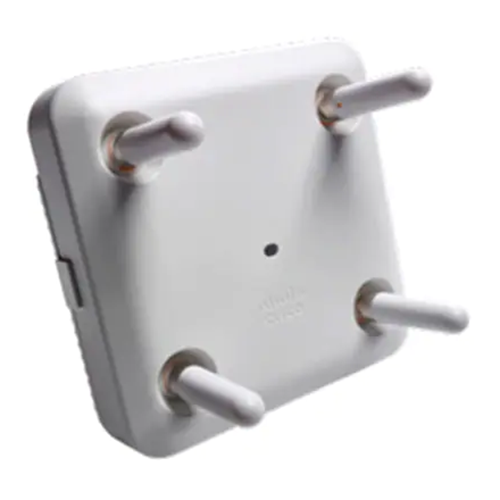
AIR-AP2802E-AK910 Cisco Aironet 2800e Eco-pack 4x4:3 MU-MIMO 10 APs
AIR-AP2802E-AK910 is a 2802E indoor access point for external antennas supplied as a fixed-domain ten-unit eco-pack with regulatory-domain token A. Cisco lists its channel profile as 2.4 GHz channels 1-11; 5 GHz blocks at 5.180-5.320, 5.500-5.700 excluding 5.600-5.640, and 5.745-5.825 GHz. Verify destination approval, controller compatibility, exact quantity, antenna bill of materials and the 31 October 2027 support horizon before purchase.
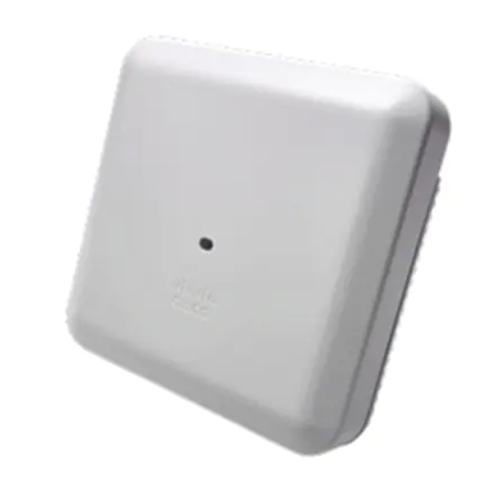
AIR-AP2802E-AK910C Cisco Aironet 2800e Enterprise 5.2 Gbps 10 APs
AIR-AP2802E-AK910C is a 2802E indoor access point for external antennas supplied as a configurable ten-unit eco-pack with regulatory-domain token A. Cisco lists its channel profile as 2.4 GHz channels 1-11; 5 GHz blocks at 5.180-5.320, 5.500-5.700 excluding 5.600-5.640, and 5.745-5.825 GHz. Verify destination approval, controller compatibility, exact quantity, antenna bill of materials and the 31 October 2027 support horizon before purchase.
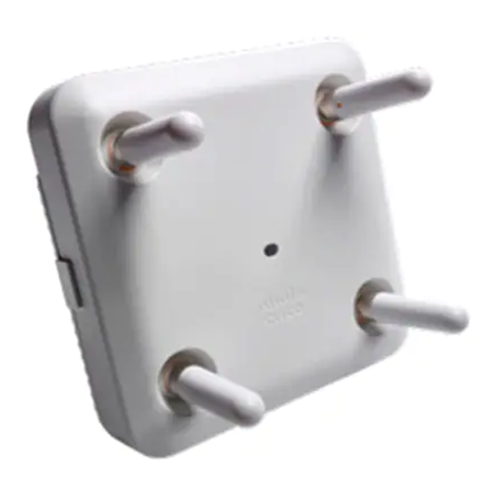
AIR-AP2802E-C-K9C Cisco Aironet 2800e Indoor WiFi5 Access Point
AIR-AP2802E-C-K9C is a 2802E indoor access point for external antennas supplied as a single-unit, configurable order with regulatory-domain token C. Cisco lists its channel profile as 2.4 GHz channels 1-13 and the 5.745-5.825 GHz upper block. Verify destination approval, controller compatibility, exact quantity, antenna bill of materials and the 31 October 2027 support horizon before purchase.