
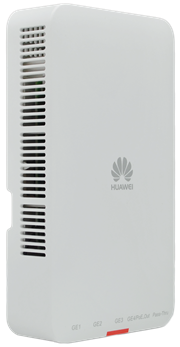
Huawei R251D-E Wall-Plate Remote Unit

- 763 412 7282
- +86 010 69614620
R251D-E Overview
Specify the E model when the room needs powered downstream equipment
Huawei provides a separate R251D-E hardware chapter. It identifies GE4/PoE_Out as an Ethernet connection supporting PoE output, whereas the R251D layout describes GE4–GE1 as data ports and lists IEEE 802.3af input. The E model’s input requirement is IEEE 802.3at. Keep those model-specific port and source roles on the room wiring schedule; a quotation for the base R251D should not be treated as evidence for the E output function.
Budget external outputs separately from the 11.5 W RU reference
The manufacturer explicitly qualifies the R251D-E 11.5 W consumption value as excluding the output power of the USB and PoE_OUT ports. Assess the downstream device and any USB load separately with the selected central AP or PSE. The cited chapter does not assign a fixed downstream-output allowance, so no particular wattage or connected-device count is promised here. Confirm the full source budget before accepting the room installation.
Separate the powered data interfaces from the passive pass-through
GE0/PoE_IN carries the uplink and PoE input. GE4/PoE_Out supports downstream data and PoE output, and GE1–GE3 are 10/100/1000M Ethernet data ports. The RJ45 Pass Through ports are separately described for transparent carriage of a network cable or phone cable. These ports are not identified as additional switched GE ports or a telephone-service gateway. Match the existing cable and outlet plan to those distinct roles.
Agree the junction-box and security-screw fit before delivery
The shared R251D/R251D-E characteristics describe installation in 86 mm, 120 mm and 118 mm junction boxes. The E hardware reference is 32.5 × 86 × 150 mm in height, width and depth, with 0.25 kg weight. Its captive-screw instructions specify an M3×4 crosshead screw, or an M3×4 torx screw with a T9 security screwdriver for the anti-theft arrangement, and 0.15 N·m torque. Verify the actual box, fixing hardware and accessory scope rather than relying on the box-size name alone.
Treat the RU and its central AP as one commissioning arrangement
The manufacturer identifies both R251D variants as remote units managed by a central AP. Their wireless module supports IEEE 802.11a/b/g/n/ac/ac Wave 2 on 2.4 GHz and 5 GHz, with built-in smart antennas. The hardware reference lists up to 256 users, expressly dependent on the environment, and 16 VAPs per radio. Confirm the central device, software and intended client-load test; the source does not establish arbitrary standalone Fat or cloud operation for the supplied RU.
Check the room environment and the hidden indicator policy
The documented operating range is 0°C to +40°C at −60–1800 m; above 1800 m through 5000 m, the upper limit falls 1°C per 300 m. Humidity is 5–95% non-condensing. The indicator is inside the panel, and the shared characteristics say it can be disabled through software to reduce light impact. Include indicator settings and the actual WLAN registration result in acceptance; an unlit panel is not, by itself, evidence of device failure.
Document/Firmware Download
R251D-E Specification
| Exact model | R251D-E |
| Deployment identity | Indoor wall-plate remote unit; central-AP managed |
| Wireless standards/bands | IEEE 802.11a/b/g/n/ac/ac Wave 2; 2.4 GHz and 5 GHz |
| PoE input | GE0/PoE_IN; IEEE 802.3at for E model |
| Powered downstream port | GE4/PoE_Out: 10/100/1000M data and PoE output |
| Other Ethernet ports | GE1–GE3: 10/100/1000M data |
| Passive pass-through | Separate RJ45 ports for network or telephone cable transparency |
| USB interface | USB2.0 storage expansion; verify attached-device and power requirements |
| RU consumption reference | 11.5 W excluding USB and PoE_OUT output power; local rules apply |
| Output-budget scope | Downstream and USB loads assessed separately; no fixed output-wattage promise |
| Base-model comparison | R251D lists IEEE 802.3af input and GE1–GE4 data; E output/USB features not transferred |
| Mounting context | 86 mm, 120 mm or 118 mm junction boxes; verify actual fit |
| Dimensions H × W × D | 32.5 × 86 × 150 mm |
| Reference weight | 0.25 kg |
| Retention screw | M3×4 crosshead or torx; T9 for torx security option; 0.15 N·m torque |
| Device memory | 256 MB DDR3L; 32 MB NOR FLASH |
| Client/VAP references | Up to 256 users, environment-dependent; 16 VAPs per radio |
| Environment reference | 0 to +40°C at −60–1800 m; upper limit derates 1°C per 300 m above 1800 m through 5000 m; 5–95% non-condensing humidity |
| Indicator scope | Hidden panel indicator; software can disable it as described in the shared characteristics |
R251D-E Warranty
 | Product Quotation |  | Condition and Packaging |
 | Return Eligibility |  | Returns and Replacement |
 | Shipping Arrangements |  | Warranty Terms |
R251D-E FAQ
What is R251D-E?
Huawei R251D-E Wall-Plate Remote Unit is a HUAWEI R200 Series Access Points product supplied by YYST Global for enterprise IT procurement and infrastructure projects.
What wireless standards/bands is listed for R251D-E?
For R251D-E, the manufacturer specification lists wireless standards/bands as IEEE 802.11a/b/g/n/ac/ac Wave 2; 2.4 GHz and 5 GHz.
What are the power requirements for R251D-E?
For R251D-E, the manufacturer specification lists poe input as GE0/PoE_IN; IEEE 802.3at for E model.
What interfaces and ports does R251D-E provide?
For R251D-E, the manufacturer specification lists powered downstream port as GE4/PoE_Out: 10/100/1000M data and PoE output.
Is R251D-E available from YYST Global?
Contact YYST Global to confirm availability for R251D-E, the required quantity, exact configuration, delivery destination and current lead time before ordering. A product listing does not confirm current inventory.
Related products
Related R251D-E
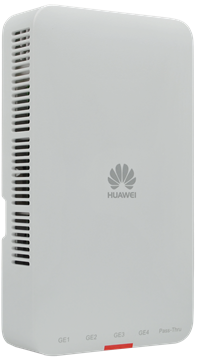
Huawei R251D Wall-Plate Remote Unit
Huawei R251D is an indoor wall-plate remote unit for Huawei agile distributed Wi-Fi, connected to and managed by a central AP. The base R251D requires IEEE 802.3af PoE input through GE0/PoE_IN and provides four GE1–GE4 Ethernet data ports plus RJ45 pass-through ports for transparent network or phone cabling. Huawei lists 11.5 W unit consumption, a 32.5 × 86 × 150 mm housing and 0.25 kg weight. The shared characteristics specify IEEE 802.11ac Wave 2 on 2.4 GHz and 5 GHz, smart antennas and installation in 86 mm, 120 mm or 118 mm junction boxes.
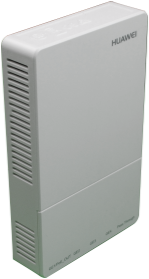
Huawei R250D-E Wall-Plate Remote Unit
Huawei R250D-E is a wall-plate remote unit connected to a central AP in Huawei agile distributed Wi-Fi. Its exact hardware chapter separates GE0/PoE_IN from GE1/PoE_OUT, provides GE2–GE4 Gigabit data connections, and lists a 48 V ±5% DC input alongside IEEE 802.3af/at PoE. A USB2.0 storage connection and an RJ45 cable pass-through support the room wiring arrangement. The documented 11.5 W consumption excludes USB and downstream PoE output power. R250D-E uses an 86 mm plate and dual-band IEEE 802.11ac Wave 2; it is not interchangeable with the simpler R250D port layout.

Huawei R250D R200 Series Agile Distributed Remote Unit
R250D is an exact Huawei R200-series remote unit used in a compatible central-AP design; it is not a standalone AP5000 access point.
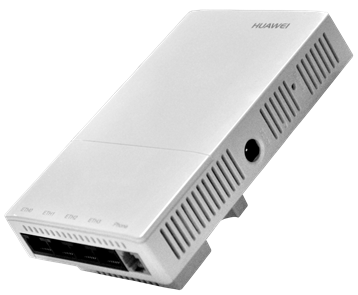
Huawei R240D Wall-Plate Remote Unit
Huawei R240D is an indoor wall-plate remote unit for a central-AP-managed agile distributed Wi-Fi system. Its room-facing ETH0–ETH3 interfaces run at 10/100M, while the GE/PoE uplink supports 10/100/1000M and PoE input. Huawei separately identifies phone connections for a POTS phone or modem and for a traditional PSTN. R240D accepts 12 V ±10% DC or IEEE 802.3af/at PoE, with an 8.7 W consumption reference. The manufacturer restricts this 86-type-box design to countries and regions supporting that box format and documents dual-band IEEE 802.11a/b/g/n/ac operation.

R230D Huawei R200 Series Indoor 802.11ac Wave 1 2x2 MIMO Access Point
Huawei R230D is an indoor R200 remote radio unit for distributed Wi-Fi, with dual-band 2x2 MIMO, one 10/100M Ethernet port and 802.3af PoE input. Confirm the central AP and software combination before ordering.