
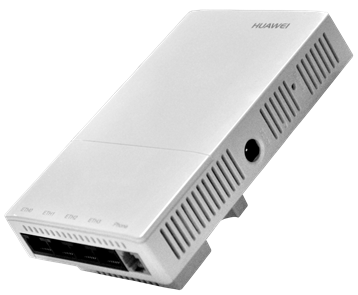
Huawei R240D Wall-Plate Remote Unit

- 763 412 7282
- +86 010 69614620
R240D Overview
A Gigabit uplink does not make the four room ports Gigabit
R240D combines a GE/PoE uplink with ETH0, ETH1, ETH2 and ETH3 room connections. Huawei assigns 10/100/1000M to GE/PoE and 10/100M to ETH0–ETH3. Specify the workstation or room-device requirement against the Fast Ethernet ports, even when the central connection negotiates at a Gigabit rate. Confirm those individual link speeds during acceptance instead of treating all five Ethernet connections as equivalent.
Preserve the two documented telephone-interface roles
The hardware chapter identifies one Phone role for a POTS telephone or modem and another for a traditional PSTN. These are distinct from the Ethernet port descriptions. The source does not establish a SIP service, voice gateway entitlement or an Ethernet-to-PSTN conversion promise. Confirm the actual telephone wiring, service provider and modem arrangement independently of WLAN provisioning before replacing an existing room outlet.
Plan both the recess and the exposed plate
Huawei gives separate height, width and depth values outside and inside the wall: 25 × 140 × 86 mm outside, and 16.5 × 51.5 × 63.5 mm inside. The stated weight is 0.2 kg. The radio table specifically limits this 86-type-box product to countries and regions that support the box format. Verify the local box, recess depth, cable clearance and fixing arrangement; the plate size alone does not confirm that it fits every regional wall outlet.
Select the power arrangement from the R240D table
The documented alternatives are 12 V ±10% DC and IEEE 802.3af/at PoE through GE/PoE. Maximum consumption is listed as 8.7 W, subject to local laws and regulations. Check adapter inclusion and source availability in the quotation and installation design. The cited R240D port list provides no PoE-output interface, so a downstream powered-device plan cannot rely on the output capability described for a different R200 model.
The central AP remains part of the service design
The shared R230D/R240D characteristics say that a central AP manages remote units and processes services centrally, while each RU processes its radio signals independently. They document IEEE 802.11a/b/g/n/ac on 2.4 and 5 GHz and an internal antenna with a hidden indicator. Confirm central-AP model and software compatibility for the deployment. This chapter does not supply a Wave 2, standalone Fat or cloud-management entitlement for R240D.
R240D offers a different wired arrangement from R230D
The separate R230D hardware chapter lists an ETH/PoE connection at 10/100M. R240D instead documents the four Fast Ethernet room ports, Gigabit GE/PoE uplink, DC input and phone-interface roles above. These distinctions explain why the two remote units should be selected against the room wiring requirement rather than substituted by their shared wireless-family description. The comparison here is limited to each manufacturer hardware chapter; no claim of interchangeable software or accessories is made.
Verify radio loading and indoor conditions on the installed system
R240D has a built-in omnidirectional antenna, with reference gains of 2 dBi at 2.4 GHz and 3 dBi at 5 GHz. Huawei lists up to 256 users and eight VAPs per radio; those limits do not guarantee real-room throughput or client capacity. Its operating range is 0°C to +40°C at −60–1800 m, with 1°C upper-limit derating per 300 m above 1800 m through 5000 m, and 5–95% non-condensing humidity. Acceptance should cover central registration, wired link negotiation and intended client use in that environment.
Document/Firmware Download
R240D Specification
| Exact model | R240D |
| System role | Indoor wall-plate remote unit, managed through a central AP |
| Room Ethernet | ETH0–ETH3: 10/100M Fast Ethernet |
| Uplink and PoE input | GE/PoE: 10/100/1000M Ethernet; IEEE 802.3af/at input |
| Telephone-device connection | Phone role for POTS telephone or modem |
| Telephone-network connection | Phone role for traditional PSTN; verify service and wiring |
| DC input | 12 V ±10%; verify supplied adapter scope |
| Consumption reference | 8.7 W; actual maximum depends on local rules |
| Outside-wall H × W × D | 25 × 140 × 86 mm |
| Inside-wall H × W × D | 16.5 × 51.5 × 63.5 mm |
| Weight | 0.2 kg |
| Installation restriction | 86-type box; only countries and regions supporting that format |
| Wireless standards | IEEE 802.11a/b/g/n/ac; 2.4 and 5 GHz per shared characteristics |
| Antenna reference | Built-in omnidirectional; 2 dBi at 2.4 GHz, 3 dBi at 5 GHz |
| Radio reference limits | Up to 256 users; eight VAPs per radio; validate actual room loading |
| Memory | 128 MB DDR2; 32 MB Flash |
| Operating envelope | 0 to +40°C at −60–1800 m; upper temperature derates 1°C per 300 m above 1800 m through 5000 m; 5–95% non-condensing humidity |
| R230D comparison scope | R230D hardware lists one 10/100M ETH/PoE; do not transfer R240D wired interfaces to it |
| Reset control | Hold Default button more than three seconds to restore factory settings |
| Indicator | Single hidden panel indicator; use documented state with registration diagnostics |
R240D Warranty
 | Product Quotation |  | Condition and Packaging |
 | Return Eligibility |  | Returns and Replacement |
 | Shipping Arrangements |  | Warranty Terms |
R240D FAQ
What is R240D?
Huawei R240D Wall-Plate Remote Unit is a HUAWEI R200 Series Access Points product supplied by YYST Global for enterprise IT procurement and infrastructure projects.
What interfaces and ports does R240D provide?
For R240D, the manufacturer specification lists room ethernet as ETH0–ETH3: 10/100M Fast Ethernet.
What are the power requirements for R240D?
For R240D, the manufacturer specification lists uplink and poe input as GE/PoE: 10/100/1000M Ethernet; IEEE 802.3af/at input.
What are the physical specifications of R240D?
For R240D, the manufacturer specification lists weight as 0.2 kg.
Is R240D available from YYST Global?
Contact YYST Global to confirm availability for R240D, the required quantity, exact configuration, delivery destination and current lead time before ordering. A product listing does not confirm current inventory.
Related products
Related R240D
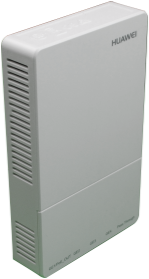
Huawei R250D-E Wall-Plate Remote Unit
Huawei R250D-E is a wall-plate remote unit connected to a central AP in Huawei agile distributed Wi-Fi. Its exact hardware chapter separates GE0/PoE_IN from GE1/PoE_OUT, provides GE2–GE4 Gigabit data connections, and lists a 48 V ±5% DC input alongside IEEE 802.3af/at PoE. A USB2.0 storage connection and an RJ45 cable pass-through support the room wiring arrangement. The documented 11.5 W consumption excludes USB and downstream PoE output power. R250D-E uses an 86 mm plate and dual-band IEEE 802.11ac Wave 2; it is not interchangeable with the simpler R250D port layout.
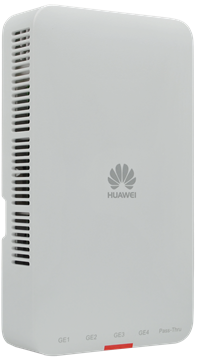
Huawei R251D Wall-Plate Remote Unit
Huawei R251D is an indoor wall-plate remote unit for Huawei agile distributed Wi-Fi, connected to and managed by a central AP. The base R251D requires IEEE 802.3af PoE input through GE0/PoE_IN and provides four GE1–GE4 Ethernet data ports plus RJ45 pass-through ports for transparent network or phone cabling. Huawei lists 11.5 W unit consumption, a 32.5 × 86 × 150 mm housing and 0.25 kg weight. The shared characteristics specify IEEE 802.11ac Wave 2 on 2.4 GHz and 5 GHz, smart antennas and installation in 86 mm, 120 mm or 118 mm junction boxes.
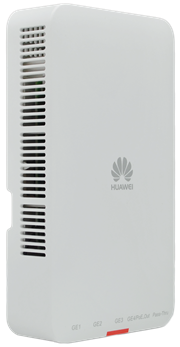
Huawei R251D-E Wall-Plate Remote Unit
Huawei R251D-E is an indoor wall-plate remote unit for agile distributed Wi-Fi, connected to and managed by a central AP. The E model requires IEEE 802.3at PoE input through GE0/PoE_IN, adds GE4/PoE_Out and a USB2.0 storage interface, and also provides GE1–GE3 Ethernet ports and separate RJ45 pass-through ports. Huawei lists 11.5 W unit consumption excluding the USB and PoE_OUT output power. The shared characteristics describe dual-band IEEE 802.11ac Wave 2, smart antennas and installation in 86 mm, 120 mm or 118 mm junction boxes; verify the exact mounting and central-AP arrangement.
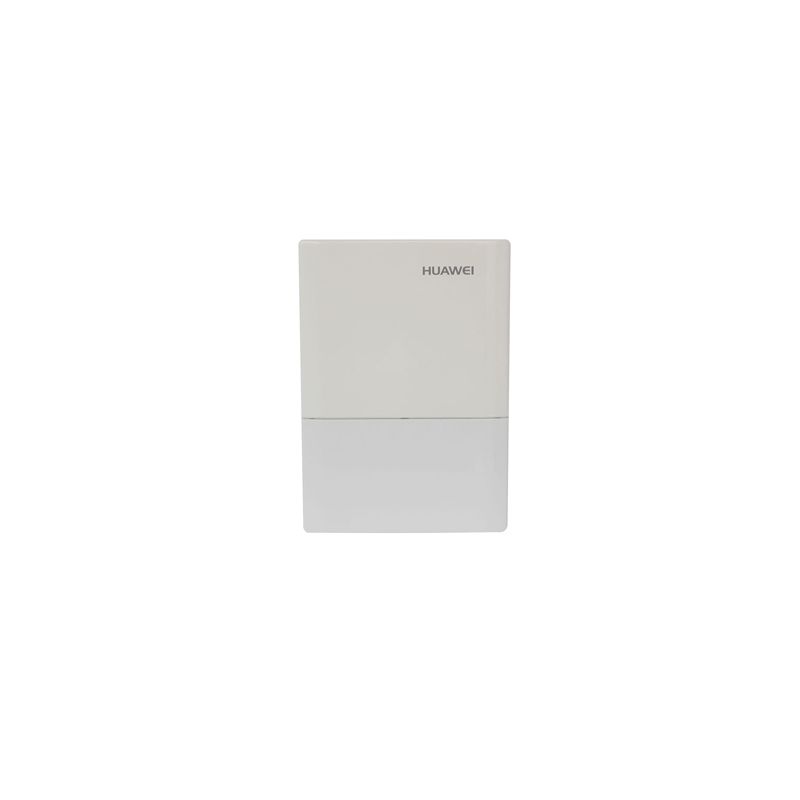
R230D Huawei R200 Series Indoor 802.11ac Wave 1 2x2 MIMO Access Point
Huawei R230D is an indoor R200 remote radio unit for distributed Wi-Fi, with dual-band 2x2 MIMO, one 10/100M Ethernet port and 802.3af PoE input. Confirm the central AP and software combination before ordering.
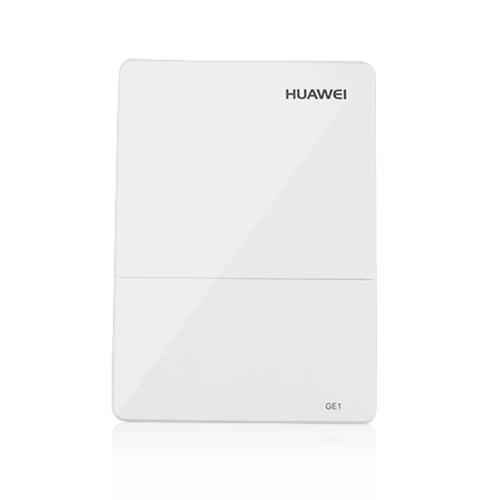
Huawei R250D R200 Series Agile Distributed Remote Unit
R250D is an exact Huawei R200-series remote unit used in a compatible central-AP design; it is not a standalone AP5000 access point.