
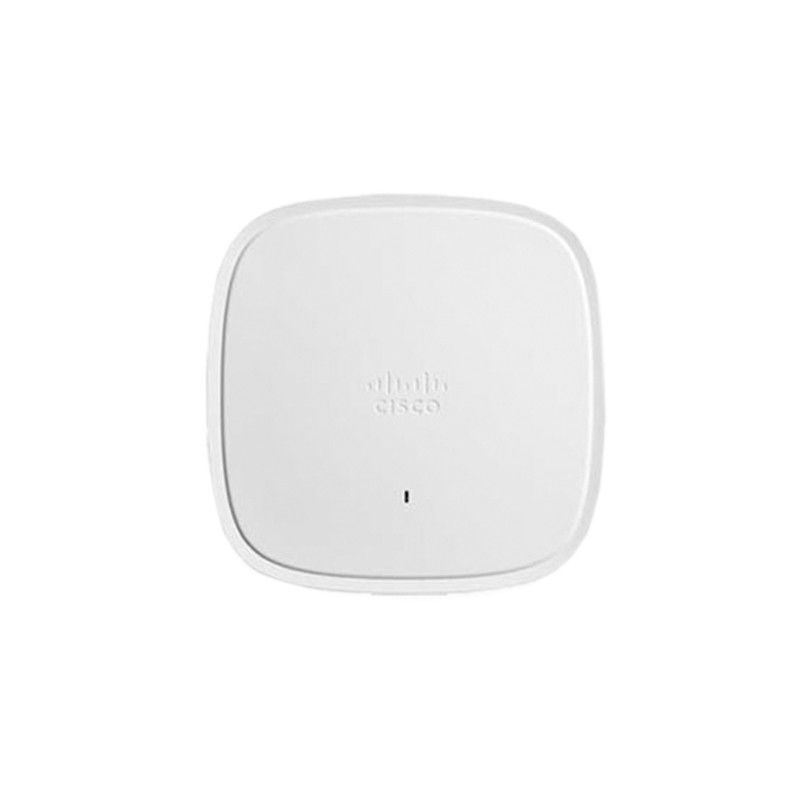
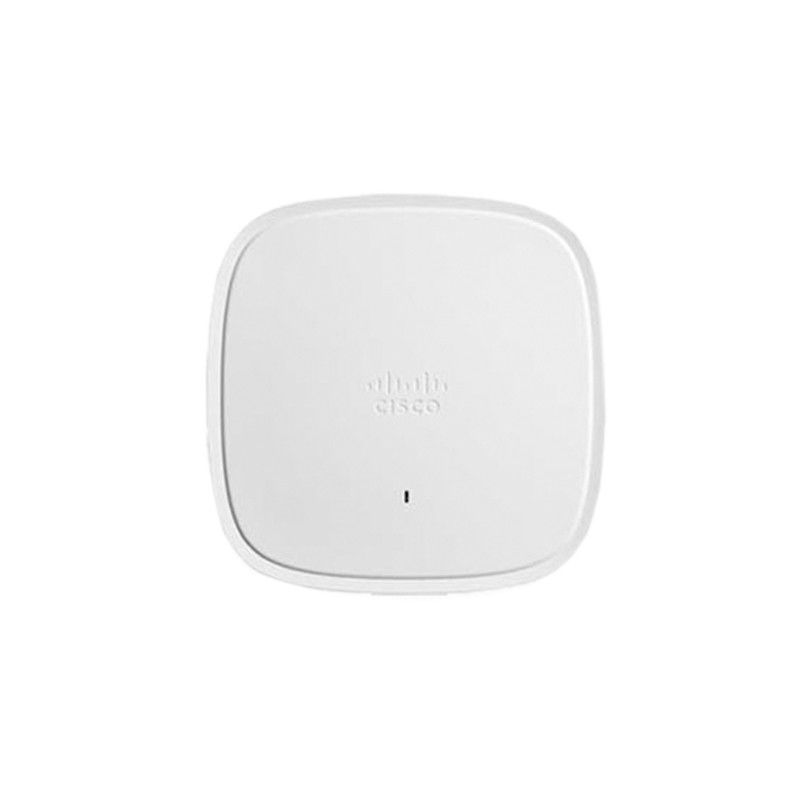
C9120AXE-I Cisco 9120AXE Industrial Dual-band WiFi 6 Access Point

- 763 412 7282
- +86 010 69614620
C9120AXE-I Overview
C9120AXE-I exact order identity
C9120AXE-I is a Cisco Catalyst 9120AX Series indoor Wi-Fi 6 access point for challenging environments with external antennas. The exact PID combines the E antenna form, a controller-based access-point order and regulatory-domain token I.
Antenna and installation boundary
Cisco specifies four external dual-band RP-TNC connectors, a four-port Smart Antenna DART connector and support for a Self-Identifying Antenna on one RP-TNC port. Antennas are sold separately. Cisco certifies the 9120AXE for gains up to 6 dBi on 2.4 and 5 GHz; preserve antenna PID, gain, pattern, cable loss and controller configuration before powering the AP. Cisco requires external antennas to be connected before power is applied; an outdoor antenna installation also requires grounding before power.
Controller-image boundary
Cisco lists this PID without the EWC infix, so the order is the controller-based access-point form rather than an EWC software-image order. Record the target controller model and release. Cisco's getting-started guide requires AireOS 8.9.111.0 or later, or IOS XE 16.11.1b or later, for the 9120AX family.
I regulatory-domain evidence
Cisco uses the final PID letter as a regulatory-domain identifier and requires customers to verify approval for the country of use. The letter is not a country name. Preserve the I-domain label in the asset record and verify that replacement stock carries the same approved regulatory identity.
Use replacement-stock readiness for the I-domain workflow. List the deployed population this unit may protect, confirm those assets use the same approved token and retain the mounting or antenna dependencies. During periodic spare testing, verify controller join and country configuration without reassigning the unit. Any cross-site use requires a fresh destination approval before installation.
Power and wired-uplink boundary
The family has one 100/1000/2500 Multigigabit Ethernet uplink. Cisco lists full 4x4 radio operation, 2.5-Gigabit Ethernet and USB with 802.3at; under 802.3af both radios reduce to 1x1, Ethernet reduces to 1 GbE and USB is disabled.
External controller decision
This PID does not carry the EWC software-image infix. Record the production controller and supported software release, and verify the live compatibility matrix before an upgrade or substitution.
Deployment evidence worksheet
Survey-to-install reconciliation
Attach the approved RF survey location, mounting height, orientation, expected client density, channel width and neighboring-radio assumptions to the order. After installation, compare measured coverage and interference with that design. If ceiling construction, antenna placement or obstructions changed, document the deviation and repeat the affected measurements. This provides a site-specific acceptance reason for the exact unit instead of relying on a family data sheet alone. Relate the installed radio mode to the survey because the flexible radio can serve 2.4/5 GHz or participate in a dual-5-GHz design.
Quotation substitution gate
Compare antenna form, regulatory token, configuration suffix, pack quantity and complete Cisco part number on the authorized quotation. Treat any changed token as a substitution that requires a new technical and regulatory review. Procurement should not accept a different access-point order merely because the family name matches. Preserve the approved line, received label and exception decision so the final asset can be traced to the exact order reviewed here. A different antenna form, EWC state or regulatory token is a different 9120AX order and requires a new technical acceptance decision.
Controlled spare policy
If purchased as a spare, name the protected site population, compatible controller image, storage location, storage conditions and periodic power-on test. Confirm that regulatory token, antenna architecture and mounting parts match the population it protects. Set a final-use review date. A stored unit can become unsuitable while untouched because controller software, country approval, certificates or network architecture may change. A stored 9120AX spare should be periodically tested for controller join, negotiated PoE state and the antenna or mounting dependencies it protects.
Monitoring handover
Assign owners for AP reachability, controller join failures, radio utilization, client health and switch-port errors. Confirm that the exact serial appears in inventory and monitoring, then test the alert path. Record dashboard object, notification route and escalation owner. Telemetry that is not tied to an owned asset does not provide a reliable service baseline and will not support later comparison after channel or software changes. Monitoring should connect the 9120AX serial to CAPWAP state, wired rate, radio utilization, client health and switch-port errors.
Change-window controls
Document staging evidence, production window, installer, rollback owner and measurable success criteria. Preserve the prior controller or AP state needed for recovery. After the change, close temporary credentials, compare authentication, monitoring and RF results with the approved baseline, and record the final decision. The work is not complete merely because the unit powers on or appears in a controller list. Rollback planning must preserve controller image, domain setting, antenna configuration and the prior AP's radio and switch-port state.
Capacity observation
Define the expected concurrent clients, application mix, airtime utilization and channel-width assumptions for this location. After commissioning, capture radio utilization, retry behavior and representative throughput during a meaningful load period. Compare the observation with the survey design and state any shortfall. A peak link rate from a data sheet is not a site capacity result and should not replace measured operating evidence. Capacity acceptance should use observed clients, channel width, airtime and retries rather than the family's maximum over-the-air rate.
Replacement dependency map
Map this unit to controller, licenses, authentication services, switch power, cable, bracket, antenna design and monitoring objects. For an end-of-sale platform, state which dependencies can be reused by the planned Catalyst migration and which require change. A nominal access-point replacement can fail when the surrounding platform was never inventoried. Keep the map with the asset rather than only in a one-time project file. For EWC orders, record the 17.15.x support ceiling and a CAPWAP conversion decision; for non-EWC orders, record the external controller lifecycle.
Handover completeness
The handover package should include exact order identity, destination approval, serial record, controller evidence, switch port, mounting or antenna record, user-path tests and named operational owners. Review the package with the receiving team and list unresolved exceptions. A unit is not operationally accepted when important evidence remains only in installer notes, email attachments or an unowned temporary dashboard. The handover package should contain the exact PID, serial, compliance result, controller assignment, antenna or mounting record and named owner.
Related Catalyst 9120 order records
- C9120AXP-EWC-I - compare antenna form and domain evidence.
- C9120AXP-I - compare antenna form and domain evidence.
- C9120AXE-EWC-I - compare controller-image state and domain evidence.
Official evidence: Cisco Catalyst 9120AX data sheet; Cisco Catalyst 9120AX getting-started guide; Cisco wireless compliance tool.
C9120AXE-I Specification
| Exact model / SKU | C9120AXE-I |
| Exact Cisco PID | C9120AXE-I |
| Product family | Cisco Catalyst 9120AX Series |
| Wireless generation | Dual-band 802.11ax (Wi-Fi 6), four spatial streams |
| Antenna form | External antenna model for challenging indoor environments |
| Published antenna boundary | Four dual-band RP-TNC ports; certified up to 6 dBi on 2.4 and 5 GHz |
| Software order form | Controller-based access point |
| Published controller baseline | AireOS 8.9.111.0 or later, or IOS XE 16.11.1b or later |
| Regulatory-domain token | I |
| Country approval | Verify the exact domain for the country of use with Cisco's compliance tool |
| Wired interface | One 100/1000/2500 Multigigabit Ethernet uplink |
| 802.3af reduced state | Both radios 1x1; Ethernet 1 GbE; USB disabled |
| Installation scope | External antennas must be connected before power; ground the AP when the antenna is outdoors |
| Source match | C9120AXE-I: 9120AXE, controller-based access-point order, regulatory-domain token I |
| Official manufacturer reference | Cisco Catalyst 9120AX official data sheet |
C9120AXE-I Warranty
 | Product Quotation |  | Condition and Packaging |
 | Technical Support Enquiry |  | Returns and Replacement |
 | Shipping Arrangements |  | Warranty Terms |
C9120AXE-I FAQ
What is C9120AXE-I?
C9120AXE-I Cisco 9120AXE Industrial Dual-band WiFi 6 Access Point is a CISCO Catalyst 9120 Series Access Points product supplied by YYST Global for enterprise IT procurement and infrastructure projects.
What wireless generation is listed for C9120AXE-I?
For C9120AXE-I, the manufacturer specification lists wireless generation as Dual-band 802.11ax (Wi-Fi 6), four spatial streams.
What antenna form is listed for C9120AXE-I?
For C9120AXE-I, the manufacturer specification lists antenna form as External antenna model for challenging indoor environments.
What published antenna boundary is listed for C9120AXE-I?
For C9120AXE-I, the manufacturer specification lists published antenna boundary as Four dual-band RP-TNC ports; certified up to 6 dBi on 2.4 and 5 GHz.
Is C9120AXE-I available from YYST Global?
Contact YYST Global to confirm availability for C9120AXE-I, the required quantity, exact configuration, delivery destination and current lead time before ordering. A product listing does not confirm current inventory.
Related products
Related C9120AXE-I
C9120AXE-S Cisco Catalyst 9120 Dual-band Controller-based 802.11ax AP
C9120AXE-S is a Cisco Catalyst 9120AX indoor Wi-Fi 6 access point for challenging environments with external antennas supplied as a controller-based access-point order for regulatory-domain token S. Verify country approval, controller release, PoE state, external antenna design and the external controller lifecycle before purchase.
C9120AXE-F Cisco 9120AX 4x4 MIMO AP for Challenging Environments
C9120AXE-F is a Cisco Catalyst 9120AX indoor Wi-Fi 6 access point for challenging environments with external antennas supplied as a controller-based access-point order for regulatory-domain token F. Verify country approval, controller release, PoE state, external antenna design and the external controller lifecycle before purchase.
C9120AXE-EWC-H Cisco Catalyst 9120 WiFi 6 4x4 MIMO AP with EWC
C9120AXE-EWC-H is a Cisco Catalyst 9120AX indoor Wi-Fi 6 access point for challenging environments with external antennas supplied as a access-point order carrying the Embedded Wireless Controller software image for regulatory-domain token H. Verify country approval, controller release, PoE state, external antenna design and the EWC lifecycle or CAPWAP conversion plan before purchase.
C9120AXE-EWC-E Cisco Catalyst 9120AX Dual-band Access Point with EWC
C9120AXE-EWC-E is a Cisco Catalyst 9120AX indoor Wi-Fi 6 access point for challenging environments with external antennas supplied as a access-point order carrying the Embedded Wireless Controller software image for regulatory-domain token E. Verify country approval, controller release, PoE state, external antenna design and the EWC lifecycle or CAPWAP conversion plan before purchase.
C9120AXE-EWC-A Cisco 9120 WiFi 6 APs With Embedded Wireless Controller
C9120AXE-EWC-A is a Cisco Catalyst 9120AX indoor Wi-Fi 6 access point for challenging environments with external antennas supplied as a access-point order carrying the Embedded Wireless Controller software image for regulatory-domain token A. Verify country approval, controller release, PoE state, external antenna design and the EWC lifecycle or CAPWAP conversion plan before purchase.
C9120AXE-E Cisco Catalyst 9120 4x4 MIMO WiFi 6 Access Point
C9120AXE-E is a Cisco Catalyst 9120AX indoor Wi-Fi 6 access point for challenging environments with external antennas supplied as a controller-based access-point order for regulatory-domain token E. Verify country approval, controller release, PoE state, external antenna design and the external controller lifecycle before purchase.
C9120AXE-D Cisco Catalyst 9120 Dual-band WiFi 6 External Antenna AP
C9120AXE-D is a Cisco Catalyst 9120AX indoor Wi-Fi 6 access point for challenging environments with external antennas supplied as a controller-based access-point order for regulatory-domain token D. Verify country approval, controller release, PoE state, external antenna design and the external controller lifecycle before purchase.
C9120AXE-A - Cisco Catalyst 9120AXE Indoor WiFi 6 Access Points
C9120AXE-A is a Cisco Catalyst 9120AX indoor Wi-Fi 6 access point for challenging environments with external antennas supplied as a controller-based access-point order for regulatory-domain token A. Verify country approval, controller release, PoE state, external antenna design and the external controller lifecycle before purchase.